
New Polling: Threats to Attack Iran Are Out of Step with the American People, Who Remain Deeply Resistant to Open-Ended Conflict
As Donald Trump prepares to deliver his State of the Union address tonight, new polling from National Security Action in partnership with Grow Progress shows Americans are broadly skeptical of military escalation with Iran and resistant to another large-scale war in the Middle East.
Americans are far more focused on their economic concerns than on escalating tensions abroad. According to recent CNN polling, just 32% of Americans say Trump has had the right priorities, while 68% say he has not focused enough on the country’s most important problems. That gap underscores the political risk for Trump: as families worry about prices and financial stability, the country is not looking for another foreign conflict.
Tonight’s speech will test whether the president responds to that reality – or instead attempts to lead the country into a war the public has not asked for.
Takeaways:
Political risks for the administration. The Trump Administration faces a steep climb in building support for anything beyond limited strikes. Without clearly defined objectives, a compelling justification, and a credible exit strategy, broader military engagement would begin from a position of public skepticism.
Americans are highly skeptical of a broad war with Iran. Across most scenarios tested, support for military action is underwater. Even in the most favorable framing – a limited strike with clear objectives – opposition outweighs support. There is no evidence of strong public demand for escalation.
Very few Americans strongly support the Administration’s plans to attack Iran. Only a small minority of Americans are strongly supportive of any form of attack on Iran. None of these scenarios approach a threshold of even 20% strong support. Just one-in-three Republicans are strongly supportive of even the most favorable framing.
Support would likely drop further in real-world scenarios. Even without mentioning casualties, costs, retaliation, or the risk of a prolonged conflict, support for military action remains underwater. If Americans were confronted with the real consequences of escalation, backing for a strike would likely decline even more.
Many Americans do not have strongly held views on a potential attack on Iran. Roughly a fifth of respondents do not have an opinion on any of the scenarios presented. Combined with the relatively low levels of strong support, this indicates that public opinion is not firmly locked in.
Results:
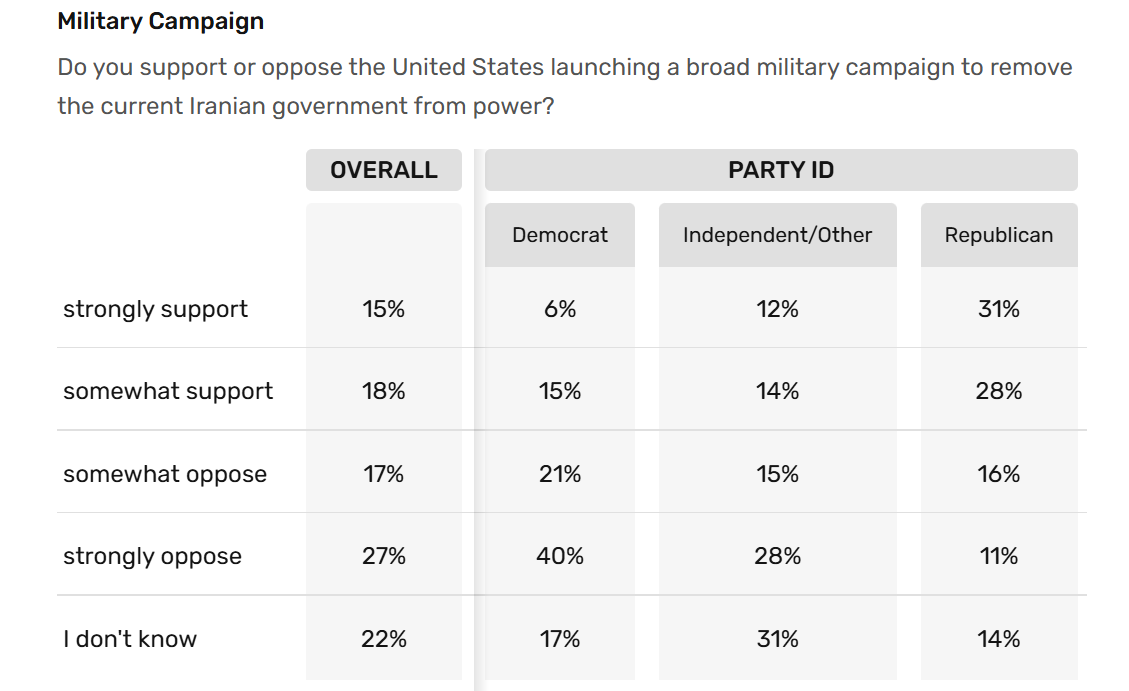
Net support: -11. A clear plurality opposes a sweeping regime change operation. Just 15% strongly support such a campaign, while opposition outweighs support by double digits. Independent voters are opposed by a 17-point margin. Even among Republicans, more than one-in-four voters are opposed to such a campaign.

Net support: -4. Support tightens when the action is framed as limited and connected to nuclear negotiations, but still remains underwater overall. Even when faced with limited scope, a clear goal, and positive outcome, fewer than four-in-ten voters support strikes.
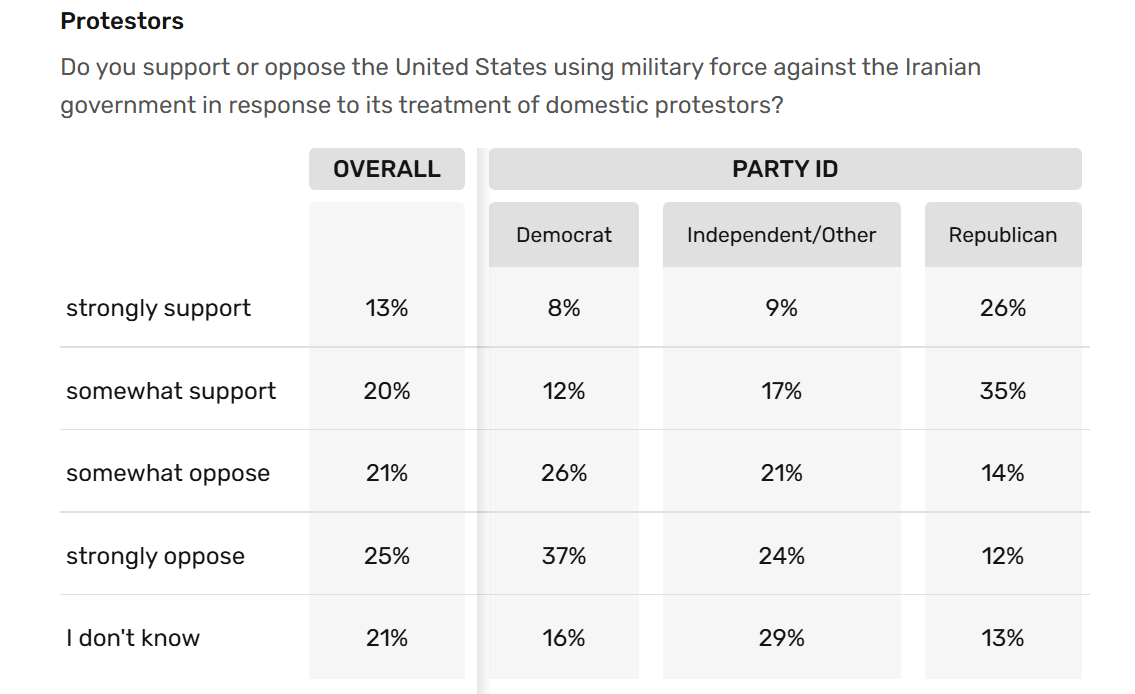
Net support: -13. Human rights justifications do not generate meaningful public support for military action. Barely one-in-four independent voters would be supportive of using military force to support protestors. This data may help explain Trump’s recent shift in rationale for attacking Iran – from protecting protestors to eliminating Iran’s nuclear program, which he previously claimed to have “completely and totally obliterated.”

Net support: -27. Americans overwhelmingly reject the idea of U.S. boots on the ground. This is the most decisive finding in the polling, with barely 1 in 10 Americans strongly in support. Even among Republicans, there is not majority support for such a broad operation, and fewer than one-in-five independent voters are supportive.
Published: February 2026